SAN TERENZO - LERICI, Lerici Fortress - Ai Voice
 Language: English / USA

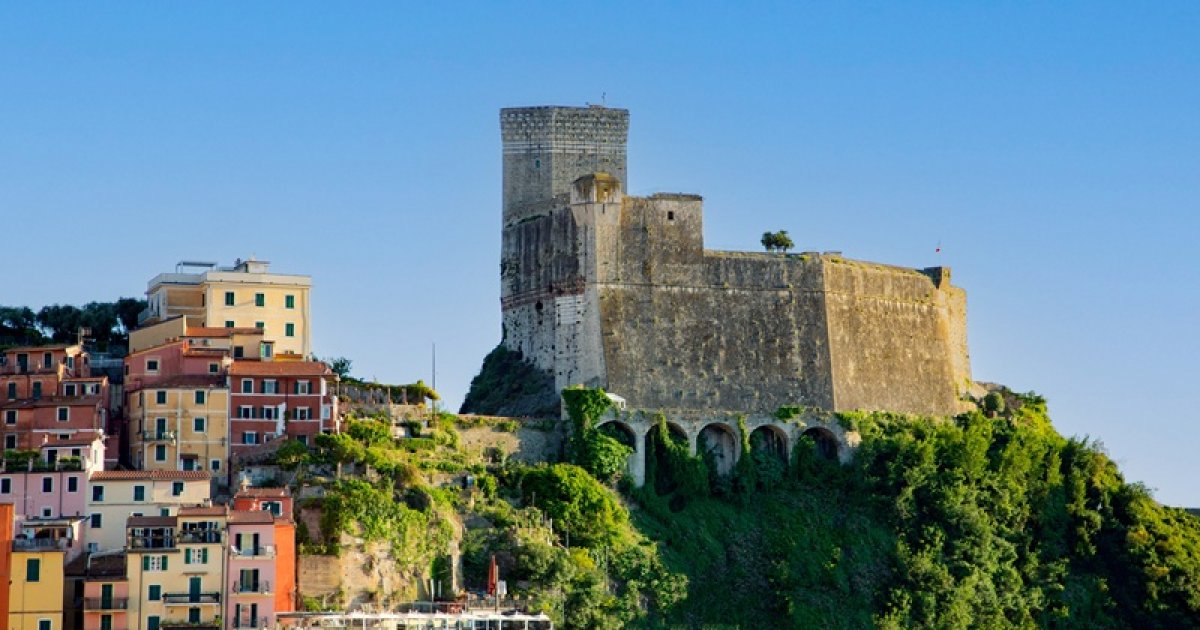
The Fortress of Lerici is one of the best-preserved examples of military architecture in Liguria. Located in a commanding position on the eastern promontory of the Gulf of La Spezia, it was built beginning in the 12th century and later expanded.
Its history is closely tied to the political and military events of the region, which for centuries was contested between the maritime republics of Pisa and Genoa.
The original construction dates back to 1152, when the Pisans controlled Lerici and began building the first defensive structure. However, in 1241, Genoa took possession of the village and the fortress, initiating a series of expansions that radically transformed the complex.
Architecturally, the structure is distinguished by its pentagonal keep, built in the first half of the 13th century and connected to massive walls and bastions that reinforced its strength. During the 15th and 16th centuries, new defensive works were added — notably a bastioned enclosure — to adapt the fortress to evolving siege techniques and the introduction of firearms. The combination of these successive modifications makes the fortress a true textbook of layered military architecture, in which centuries of adaptation can still be read in its stones.
In the following centuries, the fortress gradually lost its strategic role. After the 19th century, it was used first as a prison and later as a military depot. Finally, after World War II, it underwent restoration and structural consolidation, which made its reopening to the public possible.
Today, the fortress is open to visitors and houses the Geopaleontological Museum, featuring a collection of fossils from the Ligurian territory and the Lunigiana — a historical and geographical region located between northern Tuscany and eastern Liguria.
An interesting fact: Inside the Fortress of Lerici stands the Chapel of Saint Anastasia, a small religious building dating back to the 13th century. Originally, it was an independent oratory built on the promontory, but during the medieval expansions it was incorporated into the fortress walls.
The chapel is considered one of the few examples of Gothic architecture in Liguria. Its openings — such as windows and arches — do not have the rounded Romanesque form but end in a pointed shape. This style, known as the ogival or pointed arch, is a hallmark of Gothic architecture and makes the chapel a rare architectural feature in the region.