ARCHAEOLOGICAL MUSEUM, Farnese Atlas – Meridiana Hall - Ai Voice
 Language: English / USA

You’re standing in the Hall of the Meridian, one of the largest and most spectacular rooms in the museum. It takes its name from the meridian line traced on the floor in the late 18th century, which was used to calculate solar noon through a small hole in the vaulted ceiling that let in a beam of sunlight.
You’re about to discover one of the most fascinating and studied statues of the ancient world: the Farnese Atlas.
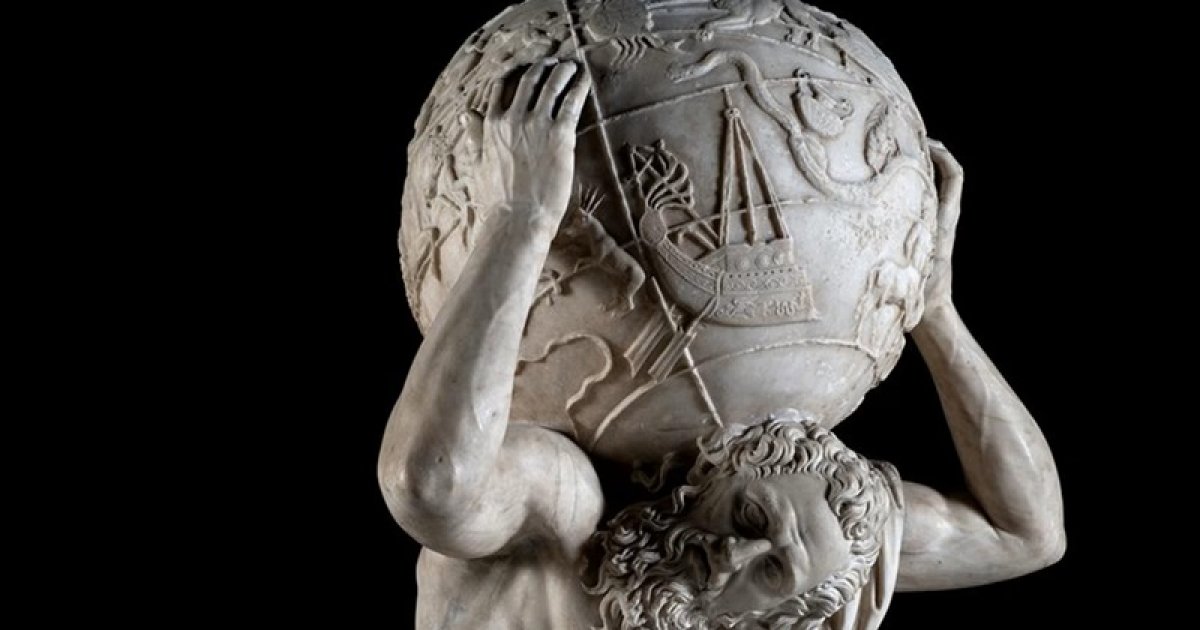
This colossal sculpture, about six feet tall, depicts the Titan Atlas bearing the celestial globe on his shoulders—a symbol of the immense weight of the universe that the gods condemned him to carry as punishment. The image of the giant bowed under the strain is incredibly powerful: it’s not just a display of technical mastery but a true expression of the human condition—enduring and persevering in the face of destiny.
The statue comes from the Baths of Caracalla in Rome, the same archaeological complex that produced several other masterpieces in the collection.
What makes the Atlas truly unique is the globe he supports. It’s decorated with more than forty constellations carved in relief, including the Great Bear, the Little Bear, Scorpio, and Cancer. It’s far more than a decorative element—it’s one of the oldest known representations of the starry sky to have survived from antiquity.
If you look closely, you’ll notice that the constellations are represented as mythological figures, blending science and legend. This fusion of astronomical knowledge and mythological imagination was typical of the Greco-Roman world.
Take a moment to observe the Titan’s face: despite his immense strength, his features are marked by fatigue, his gaze lowered, and his body bent under the effort. It’s as if the artist wanted to convey not only heroic endurance but also the fragility and suffering that come with an impossible task.
Scholars believe that the Farnese Atlas is a Roman copy of a lost Greek original, probably from the second century AD, inspired by a Hellenistic model. The sculpture was rediscovered in the 16th century and quickly became part of the prestigious Farnese family collection.
Here’s an interesting fact: Did you know that the Farnese Atlas has been used by modern scientists to study ancient astronomy? The globe has been digitally analyzed, and some researchers have suggested that the constellations’ layout is based on observations made by the great Greek astronomer Hipparchus of Nicaea, who lived in the second century BC. In other words, this marble Titan may preserve the memory of one of the earliest star maps in history!