MEDIEVAL WALLS, Presentation - Ai Voice
 Language: English / USA

The Medieval Walls of Pisa are among the oldest and best-preserved city fortifications in Italy.
Their story begins in the mid-12th century, when Pisa was a powerful Maritime Republic. Between 1154 and 1156, the city decided to build a new defensive perimeter. Construction advanced in phases: the northern section was completed in 1161, and the southern one in 1186. By the end of the 13th century, the Old Citadel had also been enclosed, further strengthening the defensive system.
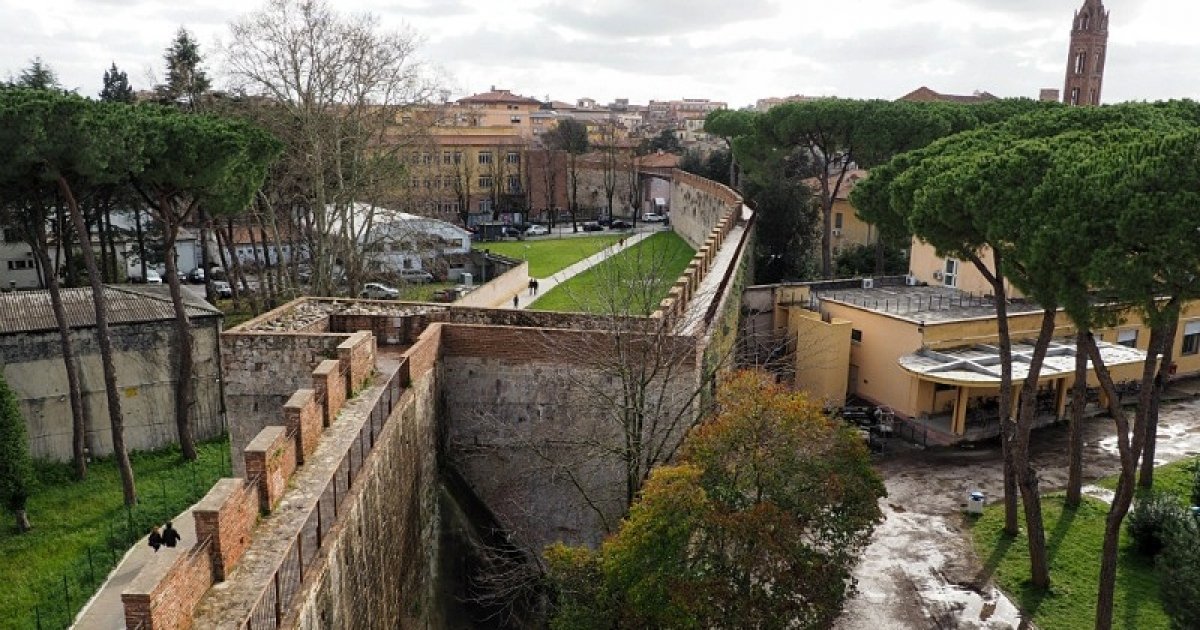
Imagine the impact: over six kilometers of walls lined with towers, walkways, and fortified gates, rising more than ten meters high on average. Looking closely, you can see that the structure is built from a mosaic of stones in varying colors — darker, compact stone from Monte Pisano at the base and lighter limestone from local quarries above.
Beyond their military purpose, the walls also controlled the flow of goods and people through gates positioned at strategic points, such as Porta del Parlascio, San Zeno, Calcesana, and Porta a Lucca — to which, in 1562, the Porta Nuova was added during the Medici era, giving direct access to the Piazza dei Miracoli.
Despite damage sustained over the centuries — particularly during World War II bombings — the walls have survived almost intact. Today, about five continuous kilometers remain, beautifully restored and enhanced by a scenic walkway opened in 2018.
The ideal route begins right at Piazza dei Miracoli, next to the Santa Maria Tower, where you’ll find the ticket office and staircase entrance. As soon as you reach the top, the view is breathtaking: the Cathedral, Baptistery, and Leaning Tower are perfectly aligned like a stage set.
Continuing on, to the right you’ll see the Jewish Cemetery, one of the oldest in Italy, and a bit further, the Romanesque outline of the Church of San Zeno, in the heart of the university district.
From the Bastion of Parlascio, you’ll have an excellent view of the wall’s layout, and descending a little further, you can visit the Baths of Nero, Roman thermal baths dating back to the 1st–2nd century A.D.
The route ends near the Wooden Tower, close to Piazzetta del Rosso. From here, you can easily reach the avenues running along the Arno River, the perfect way to end your visit with a relaxing stroll by the water.
Let me leave you with an interesting fact: the walls of Pisa were among the very first in Europe to be built entirely in stone masonry, at a time when many other cities still relied on wooden palisades or earthen ramparts.