HOUSE OF THE EPHIBE-REGIO I, House Of The Ephibe-Regio I - Ai Voice
 Language: English / USA

The House of the Ephebe takes its name from a bronze statue found in its garden — an ephebe, or young man, originally designed to hold lamps. Today, this elegant statue can be admired at the National Archaeological Museum of Naples.
This residence was among the largest in Pompeii, covering about 1,200 square meters. It was created by merging three adjoining houses, purchased at different times, and likely belonged to Publius Cornelius Tages, a wealthy Pompeian identified through a seal discovered during excavations.
The complex is organized around two atriums — large central courtyards — and a spacious garden. It had three separate entrances opening onto side streets, allowing clear separation between private quarters, formal reception areas, and the service zone used by slaves and household staff.
Inside, the rooms feature frescoes in the Fourth Pompeian Style, known for its vivid colors, architectural illusions, mythological scenes, garlands, and ornamental details. The cubicula — small private chambers used primarily as bedrooms — were richly painted with still lifes, mythological figures, decorative borders, and golden friezes, some of which are still visible today. The exedra, or main reception hall, preserves parts of its decorative scheme: the walls are whitewashed with vegetal motifs, medallions, and architectural patterns, and in some sections, birds and garlands can be discerned. Though not all the paintings have survived, what remains helps us imagine the aesthetic sophistication and visual splendor that once characterized the house.
This luxurious residence was equipped with every comfort, including a small private bath complex, complete with a system for heating water and a bronze washbasin.
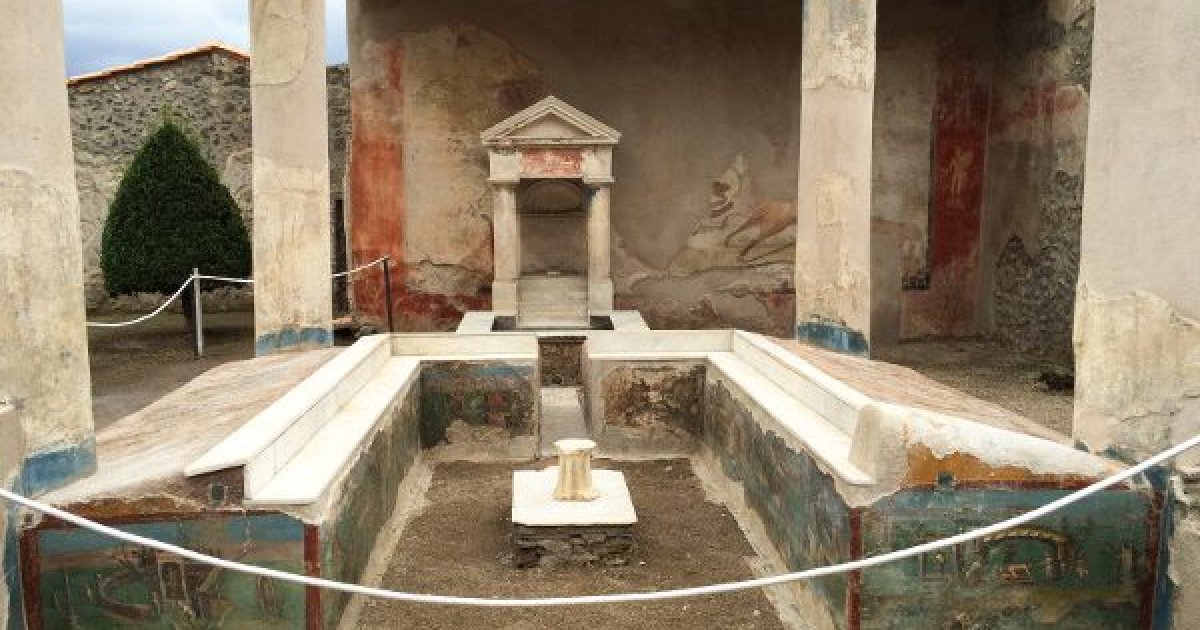
The garden was one of the property’s most spectacular features. It contained an open-air triclinium — a summer dining area with masonry couches — decorated with frescoes depicting Egyptian-inspired landscapes. An elegant fountain adorned with a statue of Pomona, the goddess of fruit and gardens, completed the idyllic setting.
Excavations have uncovered numerous artifacts, including vases, ceramics, grooming tools, glass and bronze objects, and even gilded statuettes, offering a glimpse into the refined lifestyle of its owners.
Let me leave you with an interesting fact: in ancient Greece and Rome, ephebes were young men on the threshold of adulthood, symbolizing youthful beauty, vitality, and civic virtue. Statues of ephebes celebrated the ideals of grace and strength, reflecting the period of military and civic training that marked a young man’s passage into adult life.