HOUSE OF VENUS IN THE SHELL-REGIO II, Fresco - Ai Voice
 Language: English / USA

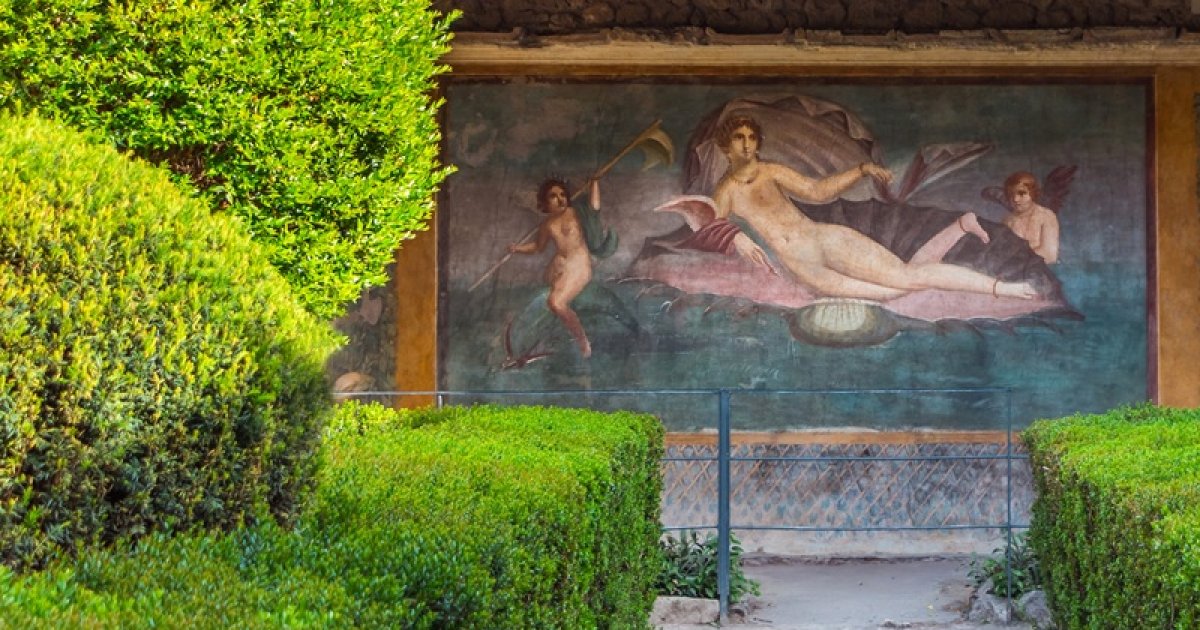
While the house itself impresses with its architectural elegance, its true fame lies in the magnificent fresco that dominates the back wall of the peristyle — a monumental wall painting nearly five meters wide and over two meters high.
The composition unfolds across three main panels, set against a deep blue background. At the center stands Venus, depicted nude and reclining within a shell carried by the waves. She wears only a few delicate jewels — a diadem, necklace, bracelets, and anklets — emphasizing both her divine nature and feminine grace. Her pale, pearly complexion reflects the classical ideal of beauty, when women of status avoided the sun to preserve a fair, luminous skin tone. Her serene expression and graceful pose convey a sense of harmony and balance: this divine nudity is not sensual but rather a symbol of pure, timeless beauty.
On either side of the shell are two cherubs: one rides a dolphin, while the other gently pushes the shell forward, completing the idyllic marine scene.
The side panels enrich the composition with symbolic details. To the left, a statue of Mars stands upon a pedestal — not the living god, but his sculpted image, alluding to the mythic lovers Venus and Mars, the union of beauty and strength. To the right, a fountain flows with clear water, surrounded by colorful birds drinking and fluttering — a delicate symbol of life and vitality.
The meaning of the fresco goes far beyond decoration. In Pompeii, Venus was not only the goddess of love and beauty, but also the protector of the city, associated with prosperity and fertility. Her presence at the heart of the garden therefore carried a blessing for domestic and social life — presiding, in spirit, over the banquets and gatherings that took place in the peristyle.
It’s important to note that this fresco was not a place of worship. Pompeian houses had lararia, small household shrines dedicated to protective deities. The Venus in the Shell was instead a decorative masterpiece with powerful symbolic and cultural significance, designed to impress guests and reflect the status and sophistication of the owners.
Let me leave you with an interesting fact: the theme of Venus’ birth has inspired countless artists through the centuries, but one of the most iconic interpretations remains Sandro Botticelli’s “The Birth of Venus,” painted in Florence between 1484 and 1486. There too, Venus stands upon a shell, carried ashore by the wind. It’s fascinating to imagine that the same image which enchanted Pompeii’s visitors two thousand years ago continued to inspire Renaissance masters, enduring as a universal symbol of beauty.