JULIET’S HOUSE, Description - Ai Voice
 Language: English / USA

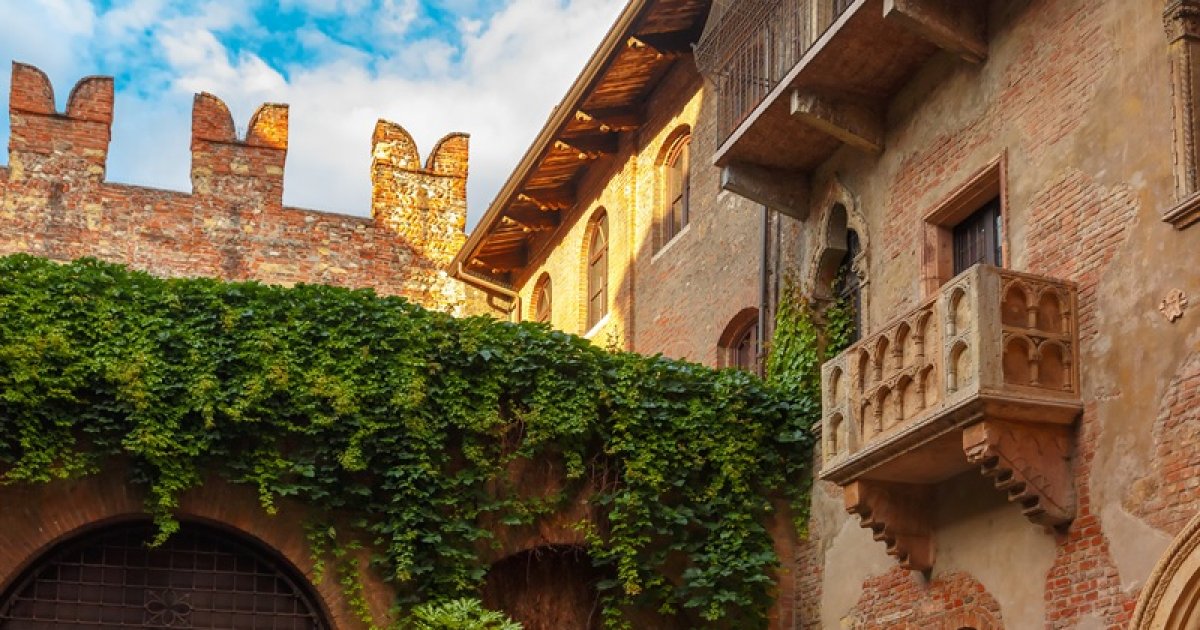
Juliet’s House is a fascinating medieval tower house. The building, dating back to the 13th and 14th centuries, is made of brick masonry and features, on the courtyard side, a façade with trilobed Gothic windows — openings divided into three lobes, resembling a small cloverleaf. This decorative motif was very popular in Verona during the rule of the Scaligeri family, the lords who governed the city in the 14th century.
The entrance leads into the inner courtyard, where a Gothic loggia with arches and stone staircases guide visitors to the exhibition route arranged across the various levels of the tower house. The current layout is the result of a 20th-century restoration directed by Antonio Avena: a Neo-Medieval setting that combines authentic historical elements from the 13th to 15th centuries with stylistic additions meant to evoke the atmosphere of Shakespeare’s legend.
Inside, the rooms display artworks and furnishings inspired by the theme of Romeo and Juliet. Among the main spaces are:
• The Balcony Room, dedicated to the visual iconography of Shakespeare’s tragedy;
• The Ballroom, featuring a wooden floor and ceiling and a red marble fireplace adorned with the Cappello family coat of arms, a reminder of the house’s original owners;
• The Bedroom, accessible via a gallery overlooking the courtyard, which showcases the bed designed by Lorenzo Mongiardino for Franco Zeffirelli’s 1968 film Romeo and Juliet. This room also displays paintings and sculptures from the 14th and 15th centuries, and its windows open onto enchanting views of the courtyard and historic façade.
The house also preserves late-14th-century frescoes, wooden furnishings, and historical artifacts that together recreate the atmosphere of a noble Veronese residence from the Middle Ages, reinterpreted through the early-20th-century museographic taste.
Let me leave you with an interesting fact: as mentioned earlier, the famous balcony you see is not original. It was added in the 20th century during the restoration works. To build it, a 15th-century stone slab from another Veronese building was reused, with added supports and decorative Gothic elements. Its design was inspired by Verona’s typical “hanging tombs” — small funerary monuments that project from church façades. In this way, history and imagination came together to create the most famous balcony in the world.