SANT PAU MODERNIST COMPLEX, Administration Pavilion - Ai Voice
 Language: English / USA

In front of you stands the heart of the Sant Pau Art Nouveau Site:
the Administration Pavilion, a masterpiece of architecture and decorative arts that once welcomed visitors.
Lluís Domènech i Montaner designed this building as a true monumental gateway.
Its richly decorated main façade was not meant to be just a functional entrance, but also a symbolic statement of moral and spiritual values: charity, science, and hope—the principles that guided the hospital’s mission.
Here, architecture becomes a symbolic language, where every decorative element tells part of the story behind the project.
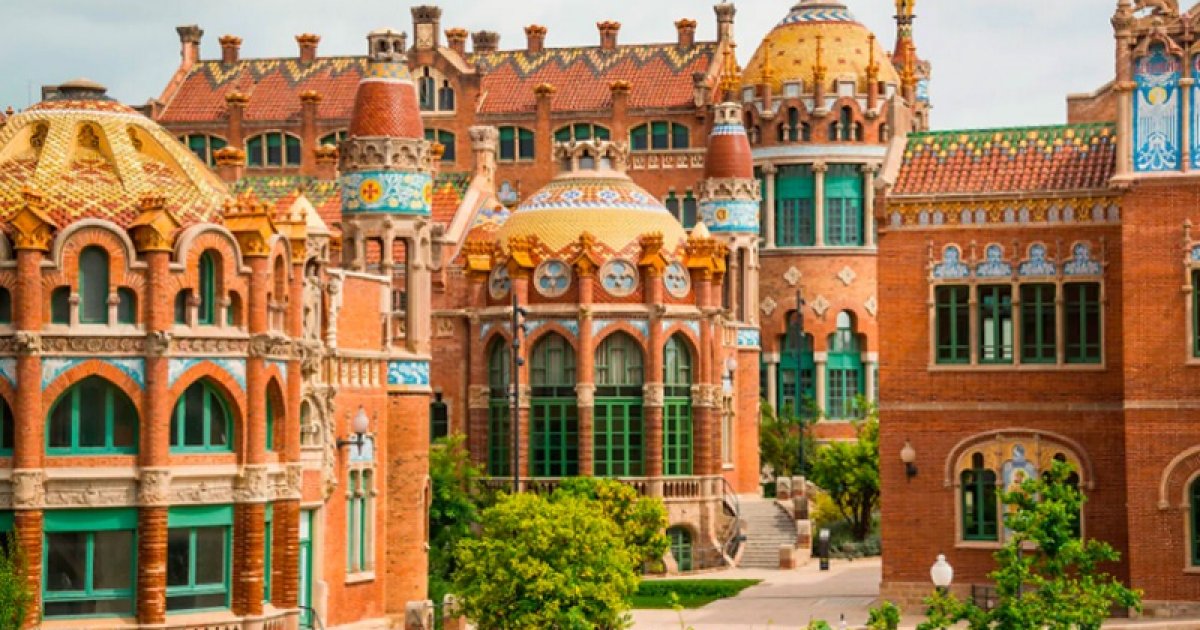
Built between 1902 and 1912, the pavilion elegantly combines exposed brick, multicolored ceramics, carved stone, and stained glass.
The result is a vibrant, light-filled façade.
Typical Modernisme curves intertwine with Gothic-inspired elements reinterpreted in a modern way, creating a perfect balance between tradition and innovation.
At the center of the façade, the large arched entrance stands out, crowned by the coat of arms of the Hospital de la Santa Creu i Sant Pau and flanked by floral decorations and religious symbols.
Above it, mosaics depict Saint George—patron saint of Catalonia—along with other allegorical figures celebrating faith, science, and compassion.
Two major artists of Catalan Modernisme played a leading role in the sculptural decoration:
– Eusebi Arnau, who created the allegorical figures and symbolic reliefs, and
– Pau Gargallo, a young sculptor who would later collaborate with Picasso.
Arnau brought a refined, idealistic style with serene faces and elegant drapery, while Gargallo added movement and realism, foreshadowing his later shift toward Cubism.
Together, their works give the pavilion an almost theatrical dimension, where every detail contributes to the narrative.
Dominating the entire complex is the 62-meter-high clock tower.
Its octagonal spire, decorated with golden ceramics and wrought-iron crosses, recalls Gothic bell towers, yet with the lightness characteristic of Modernisme.
Inside, the pavilion originally housed the hospital’s administrative offices and management.
The interiors, richly decorated with frescoes, stucco, and stained glass, show the same aesthetic care dedicated to the patient pavilions—because for Domènech, every task should be carried out in a space inspired by beauty and human dignity.
Today, after meticulous restoration, the Administration Pavilion has become the visitor center of the Sant Pau Art Nouveau Site.
Here you’ll find the ticket office, introductory exhibitions, and a space that explains the history of the complex and its architect. Entering the building, you can admire the stunning ribbed vaults, original mosaics, and the colored light filtering through the stained glass windows—an experience that perfectly captures the spirit of this place.
An interesting fact: Standing 62 meters tall, the clock tower makes the Administration Pavilion one of the highest points in the entire neighborhood. In the past, its bell marked the passing hours for the whole hospital.